


The Safeguard America Voter Eligibility Act would be a big boost in that regard.
For now, Trump has signed an executive order that would provide states a federal “citizenship list” and would also prioritize investigations and enforcement of alleged election fraud.
But the biggest change comes in the U.S. Mail.
In May, the Postal Service posted a notice of its efforts to comply, beginning with an amendment to the Mailing Standards of the United States Postal Service, Domestic Mail Manual (DMM).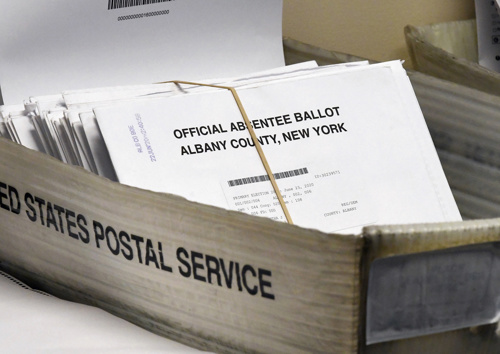
The change would apply specifically to the “transmission of mail-in or absentee ballots for federal elections.”
These measures, too, would be a big boost — if they survive legal challenges from the Left.
The EO, dated March 31, directed the Postal Service to begin rulemaking that would require official election mail to use standardized envelopes with unique Intelligent Mail barcodes or similar tracking technology. The proposal would also establish procedures for states to notify USPS of mail-ballot plans and create state-specific lists of voters authorized to receive mail ballots through USPS.
Alabama Attorney Gen. Steve Marshall has been joined by 12 other AGs in filing a comment letter in support of the new U.S. Postal Service rule.
Katherine Robertson, chief counsel to the Alabama AG, said on “Washington Watch” that the litigation against this rule shows that it has become a red state-blue state issue.
“And you hate to think that election integrity is so polarizing and so partisan, but that is clearly the case,” she told show host Jody Hice. “You saw a bevy of blue states immediately come in and sue, and you have to ask yourself: why is that? Why is it that the red states want election integrity and the blue states don't?”

This initiative, she explains, is Trump doing what he can with the tools that he has as he waits for Congress to act, changing how Americans register to vote and eliminating most mail registration methods.
“This particular rule is designed to utilize the authority of the United States Postal Service to strengthen the integrity of that part of voting. Obviously, lots of ballots are cast by mail, absentee ballots and otherwise. What he's proposed to do is to keep a national list, a national voter registry that has to be checked before a ballot can be mailed out,” Robertson states.
The barcode system will ensure that the ballots are going from one place to another in a way that maintains ballot security, she said.
“The state's reaction to that, or at least the 13 states that joined our letter, is to say thank you for being willing to do the part of this that we cannot secure on our own,” Robertson says.
An interesting part of the rule, she notes, is that this bill is still in the comment period — not yet final — but there are people prejudging what they think the outcome should be.
According to CBS News, 23 Democrat states and the District of Columbia have filed a lawsuit, led by California, to block Trump’s executive order. Reuters reports that a federal judge has already blocked the Postal Services, proposed restrictions.
“I think one judge up in the Northeast has already purported to put an injunction nationwide in place so that these measures cannot be implemented in the states that sued,” states Robertson. “There's a long road ahead as is the case unfortunately for most election integrity measures.”
In it for the long haul
Critics believe this will end up in federal court, and Robertson says it will take some time before these ongoing challenges reach finality. She emphasizes this is not just a fight for the next election, but for future elections, as they work to get the injunction released and continue to litigate.
“We continue on with the APA (Administrative Procedure Act) process to get a rule finalized, and then the group of states that's on our side will continue to come in and defend the administration's position,” states Robertson. “What you'll see is probably this will get up to a circuit split at some point and then make its way to the United States Supreme Court, but we're hoping that we get the rule implemented in the meantime that's our goal.”
It is important to note that not all red states line up with Trump’s desire to eliminate mail-in ballots. Last Monday, the Supreme Court ruled in favor of a Mississippi law allowing mail-in ballots to be counted if it is postmarked by and receive within five days of Election Day, reports SCOTUSblog.
According to Mississippi Today, a dozen of other states will be allowed to count main-in ballots after Election Day because of this ruling, dealing a blow in Trump’s agenda to vote-by-mail.