



Republicans may ultimately win that political fight, Dave Wasserman, senior editor for the Cook Political Report, said on “Washington Watch” Tuesday. But he doesn’t believe the net gain for the GOP will be enough to win the grand prize – control of the House of Representatives.
States’ efforts to redraw congressional voting maps to match controlling parties within their legislatures were already under way when the U.S. Supreme Court ruled 6-3 last week in Louisiana v. Callais, adding legal fuel to the political fire.
With the 200-mile, snake-like 6th District in its crosshairs, the Court held that using the Civil Rights Act to draw majority-black congressional district lines violated the Equal Protection Clause of the Constitution’s 14th Amendment.
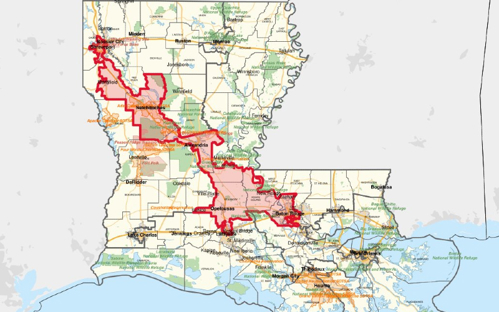 The Court did not say that race can’t be considered in the drawing of voting maps, but it did place limits on how race is considered.
Just north of Louisiana, Mississippi's majority-black 2nd District covers approximately one-third of the entire state.
That district is so large because the Mississippi legislature must balance the state's population of 2.95 million among the state's four congressional districts, including the sparsely populated 2nd District.
“Each party is trying to maximize its advantage where it can. Ultimately, with this decision, I believe there will be around three seats that are wiped out across the South by Republicans. The ultimate net gain out of this remap war for 2026 is likely to be a modest Republican gain, probably not enough to save their House majority, though,” Wasserman told show host Jody Hice.
Republicans currently hold 218 seats to Democrats’ 215 seats, meaning they can afford only one defection in and still pass legislation without Democrat votes.
The Callais ruling has put a spring in the steps of GOP House members as red states like Alabama, Florida, Tennessee and Mississippi are planning to redraw congressional lines, or at least state officials are discussing it.

“Keep in mind that by 2029 we could see states across the Deep South sending zero Democrats, or black representatives to Congress, from states that have some of the highest black populations in the country," Wasserman said.
"And so," Wasserman continued, "this is going to have the effect of eradicating Democrats from red states, and blue states are eradicating Republicans from their delegations."
The polarization is not just beginning but could worsen.
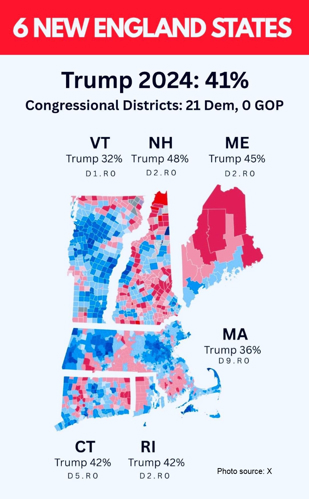
In the New England states — Maine, New Hampshire, Vermont, Massachusetts, Rhode Island and Connecticut — Republicans often show 35-45% of the vote share but hold only one of a combined 33 congressional seats.
While Illinois and California are decidedly blue states, they currently have a combined 12 — three in Illinois, nine in California — Republicans among their congressional delegations.
 That’s a big loss should those Democrat-controlled states draw lines to wipe out all 12 GOP seats.
“We could see in Illinois, for example, Democrats in advance of 2028 pass a map with 17 Democrats and zero Republicans by drawing a series of strings from Chicago out to downstate Illinois. Same thing in California. Democrats could draw a 52 to nothing map,” Wasserman said.
In the short term, if the rush to redistrict in red southern states yields only three Republican House seats in the November elections, as Wasserman predicts, that’s not nearly enough to off-set his projected gain of 15 seats for Democrats, an increase he attributes to President Donald Trump’s current approval rating.
Most polls show Americans favoring Trump between 36-40%.
The thing about redistricting …
The other thing to consider in redistricting is that sometimes districts may surprise with how they vote.
Texas Republicans, who fired the first redistricting salvo, drew a number of districts around Hispanic majorities, a demographic in which Trump showed great improvement in 2024. Exit polls showed Trump took in as much as 42% of the Hispanic vote after earning just 32% in 2020.
“But with the reversion to Democrats we're seeing among Hispanic voters, some of those districts might not perform as Republican as intended,” Wasserman said.
When the dust settles on redistricting, a handful of states — those with provisions in place to ensure neutral voting maps — will decide which party controls the House.
“What it means is that the battle for control of the House is going to come down to a small group of states with neutral maps that were installed by courts or commissions. That’s why the bulk of the toss-ups in our chart right now are in Arizona, Michigan, Pennsylvania, Iowa … states where neither party dominates this process,” Wasserman said.