

But while the Senate voted 51-48 to begin debate on SAVE America Act, the path to strengthening election integrity remains long and complicated.
Democrats, claiming the bill would disenfranchise millions of eligible voters, have put up a wall of defiance, leading to calls for Senate Republicans to abandon the filibuster, the time-honored tool to strengthen the minority party’s voice in contentious legislative matters.
As the filibuster remains, Republicans, the majority party with 53 seats, need 60 votes to pass the bill. Not only do Republicans lack the votes to pass the bill, they lack the votes to get rid of the filibuster, many citing future concerns when they find themselves as the minority party, Senate Majority Leader John Thune says.
The GOP couldn’t even begin debate with unanimous consent among its members. Sen. Lisa Murkowski (R-Alaska) voted with the Democrats, and Sen. Thom Tillis (R-North Carolina), who has opposed the bill, did not vote.
Tillis says he agrees with the legislation in spirit but also believes debate is a “waste of time.”
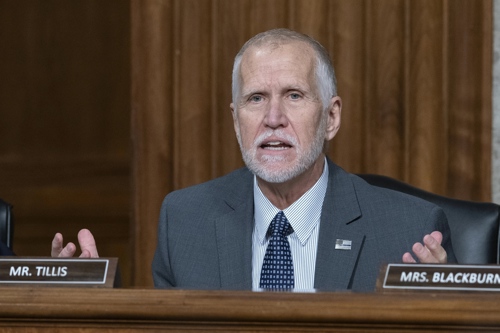 “People on my side of the aisle — and people at the far right of the political spectrum — are trying to swing for the fences, and they’re not going to succeed,” he told reporters last week. “And we’re not going to have more states with more voter ID, which is what I want. In the process, we are setting up vulnerable Republicans for a more difficult environment than they already have.”
Debate is expected to continue for the remainder of the week and perhaps into the weekend.
Adding to the drama are potential revisions encouraged by President Donald Trump that would enhance requirements for voting by mail and would add prohibitions on biological males in female sports and gender-mutilation procedures for minors.
“I think I'd start off by saying that that 80% of Americans believe in voter ID. Seventy percent of Democrats want voter ID – 70% of Democrats – but why will not one Democrat senator say they support voter ID?” Sen. Roger Marshall (R-Kansas) asked on “Washington Watch” Wednesday.
Indeed, Democrat support for the SAVE America Act is hard to find.
Fetterman: Voter ID, yes; SAVE America Act, no
Sen. John Fetterman (D-Pennsylvania) has expressed support for voter ID but not for the bill in its current form.
A Pew Research poll last summer showed American support for photo ID at the ballot box at 83%.
Marshall told show host Jody Hice that media are asking the wrong questions.
“When you register, it requires proof of ID, of who you are when you vote. Then we basically verify who you are when it comes to mail-in ballots and put some guardrails around that. So, if they're against any of those other two rails, why are they against voter ID? I think that's what you're going to be exposed to.”
 Filed originally by Rep. Chip Roy (R-Texas) and Sen. Mike Lee (R-Utah) as the Safeguard American Voter Eligibility (SAVE) Act, the bill passed the House but stalled in the Senate in 2025.
Revived, tweaked and renamed, it is sitting in the Senate again.
The bill requires individuals to provide documentary proof of U.S. citizenship—such as a passport or birth certificate—when registering to vote in federal elections.
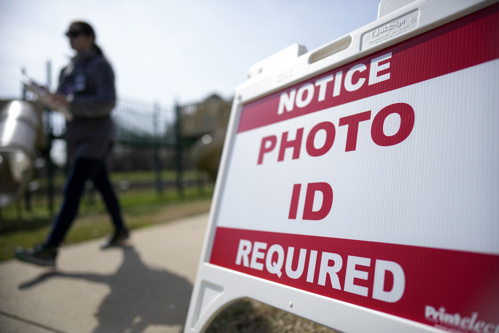
It also imposes strict photo ID requirements for voting, excludes student IDs, and mandates that mail-in voters submit photocopies of their ID with both their ballot application and ballot.
Democrats say the increased scrutiny would disenfranchise millions of eligible voters.
Sixty percent of Americans are concerned about election integrity, Marshall says, and there are two reasons.
“No. 1 is the number of illegal immigrants that have come into this country. A lot of people are worried that their vote is going to be cancelled by an illegal voter.’ The other thing that really has folks’ attention are these unsolicited mail-in ballots,” he said.
Vote-by-mail concerns
A New York Times source in August of 2020 predicted, based on prior election trends and possible turnout increases, that roughly 80 million mail-in ballots would be sent to election offices that fall. That projection more than doubled the number of ballots that were returned in 2016.
In 2024, more than 48 million mail-in ballots were cast and counted, according to the U.S. Election Assistance Commission.
 Currently, municipalities in the states of California, Maryland and Vermont, plus Washington, D.C., allow noncitizen residents to vote in local elections.
The Illegal Immigration Reform and Immigrant Responsibility Act of 1996 prohibits noncitizens from voting in federal elections.
There is often legitimate need for mail-in voting, such as with military personnel, Marshall says, but strengthening the ID process is important.
“There are other reasons for good for mail-in ballots, but we need to verify who you are and take that extra step as well. So again, 80% of Americans believe in voter ID, and a good chunk of them are concerned about the election integrity in general,” Marshall said.