


During his testimony, Garland stood in defiance of House members and their congressional oversight responsibilities, Rep. Harriet Hageman (R-Wyoming) told the Washington Watch program Tuesday.
Garland’s time for lawmakers was filled with “I can’t answer that, I don’t know or that’s something we’re investigating,” Hageman said.
Often, such as with Garland this week, the intention is to “deflect attention, to stonewall,” Hageman said.
Garland’s latest testimony comes after House members threatened contempt charges against him in March for failing to comply with a congressional subpoena to turn over audio recordings related to Special Counsel Robert Hur’s investigation into Biden’s classified documents probe.

Unelected officials such as Garland are often offended by congressional oversight, Hageman told show host Tony Perkins.
“This is one of the reasons the Deep State really is congruous with the unelected bureaucracy in Washington, D.C. You have these agencies staffed with people who believe Congress should not have any oversight into what they do at all," the Congresswoman warned. "We’re moving to a system where we are being governed by an unelected bureaucracy rather than being a republic with a representative form of government.”
The committee hoped to determine the level of contact, if any, between Garland and DOJ staff with Atlanta District Attorney Fani Willis, Manhattan District Attorney Alvin Bragg and New York Attorney General Latitia James.
Garland’s responses yielded little information, she said.
Rep. Matt Gaetz (R-Florida) didn’t get much out of Garland either but the fiery GOP lawmaker led the attorney general down a path in which his non-answers were very telling.
Gaetz asked Garland for copies of all correspondence between the DOJ, Bragg’s office, Willis’ office and James’ office.
“The offices you are referring to are independent offices of state governments. We do not control those offices; they make their own decisions,” Garland correctly answered.
Garland could provide copies of communication, involving DOJ staff. He refused.
“If you make a request with our office of legislative affairs …” he responded.
But Gaetz cut him off.
Garland advances his conspiracy theory
“Here’s the thing: you come in here, and you lodge this attack that it’s a conspiracy theory that there is coordinated lawfare against Trump. Fine, just give us the documents, give us the correspondence, and if it’s a conspiracy theory that will be evident," Gaetz told Garland. "But when you say, ‘Well, we’ll take your request, and we’ll sort of work it through the DOJ’s accommodation process,’ then you’re actually advancing the very dangerous conspiracy theory that you’re concerned about.”
Gaetz then shifted tactics and asked Garland about his time as a judge. Before moving to DOJ, Garland was an appellate judge in Washington, D.C., first appointed by Bill Clinton in 1997.
Gaetz asked Garland if he’d ever made political donations to candidates.
 “No,” Garland replied, adding after further prompting that a federal rule barred judges from such contributions.
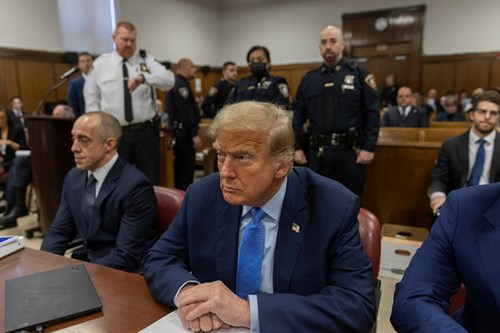
“Under that same theory of attacks on the judicial process, shouldn’t someone be owed like a jury of their peers and a judge that’s non-biased rather than getting a judge from your political opponent’s donor file?” asked Gaetz in reference to Judge Juan Merchan, who presided over Donald Trump’s New York case.
The former president, prosecuted by Bragg, last month was found guilty of falsifying business records in relation to hush money payments to a former porn actress.
“I’m well aware that you’re not asking a hypothetical. You’re asking me to comment on a jury verdict in another jurisdiction that has to be respected. I won’t comment on it. That case is still ongoing,” Garland said.
Gaetz pushed harder.
“Was there ever a time that you had a family member who was personally profiting off the notoriety of a case that was before your court?” Gaetz asked, referencing Merchan’s daughter, Loren Merchan.
The New York Post reported that Democratic clients of Loren Merchan raised almost $100 million off the Trump case.
 “I’ll say it again: it’s very clear you’re asking me to comment on a case in another jurisdiction,” Garland replied.
On the topic of lawfare and politics, Garland then denied any connection with Matthew Colangelo, the now-former U.S. assistant attorney general under Garland’s authority. Despite being a top DOJ lawyer, Colangelo made the seemingly odd career move to become an assistant D.A. in the office of Alvin Bragg.
“I’m saying it’s false. I did not dispatch Mr. Colangelo anywhere. I assume he applied for a job there and got the job. I had nothing to do with it,” Garland said.
Gaetz cited an excerpt from the Mark Pomerantz book, “The People vs. Donald Trump.” Pomerantz was the lead attorney in Bragg’s investigation of Trump before Pomerantz resigned abruptly in February of 2022.
The book says, “We put together the legal eagles to get Trump. We got all these folks together, and we assembled them for that purpose,’” Gaetz said. “When we on the judiciary committee think about attacks on the judicial process, our concern is that the facts in the law aren’t being followed, a target is acquired, Trump, then you assemble the talent from DOJ, Mr. Pomerantz, and you bring everybody in together. Meanwhile, the judge’s family is making money for something you yourself wouldn’t do.”
Editor's note: Headline revised after story originally posted.