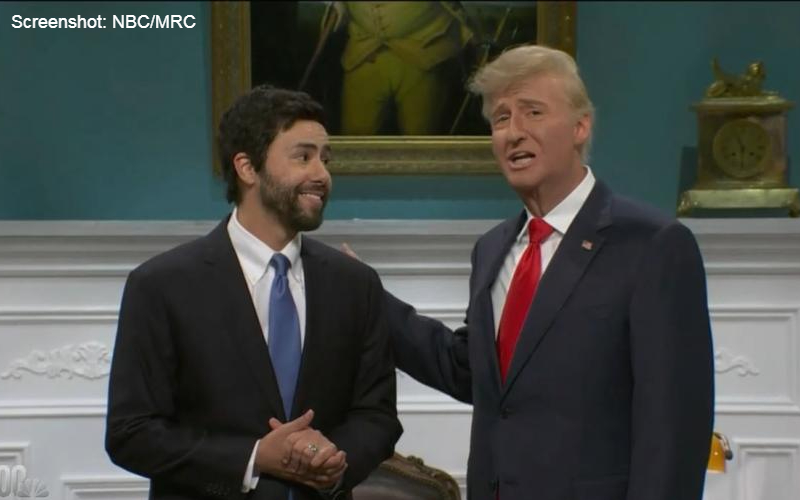




After the latest polling, Republican strategists must feel an awful lot like Democrats did during Joe Biden’s “Weekend at Bernie’s” debate performance — sick.
The lopsided numbers screaming from the latest generic ballots have not course-corrected after a rocky summer, despite the absurd things coming out of the mouths of unapologetically anti-American candidates like Abdul El-Sayed (D). Now, with a handful of weeks until the midterms, conservatives are clinging to the hope that the election forecasts — like the weather — will be wrong.
As recent history proves, it’s not entirely wishful thinking.
“The generic ballot can give us a window into the political environment, but there’s no such thing as a generic congressional race,” Nathan Gonzales, editor and publisher of Inside Elections, warned.
That’s not to say that Democrats don’t have an incredible advantage at this moment — they do. Even the most trustworthy polling houses say the dashboard is blinking red for the GOP heading into the November elections. But a lot can happen in four weeks.
For now, analysts seem to agree that Minority Leader Hakeem Jeffries’s (D-N.Y.) party isn’t experiencing what the industry calls “an artificial sugar-high” in polling. On the contrary, the consensus is that it’s the Democrats’ momentum to lose. And while Harvard-Harris’s monthly report insists the two parties are neck and neck, other trustworthy people in the business, like Cook Political Report, acknowledged that at least for the moment, Democrats could be on the verge of five to 15 pick-ups in the House.
Dave Wasserman, senior editor and elections analyst at Cook, admitted the math can be confusing. “… [R]ight now, Republicans effectively have a 220 to 215 majority, which means that Democrats would only need to pick up three seats to get to that magic number of 218 to flip control. However,” he cautioned, “it’s not as simple as that, because Republicans embarked on an unprecedented strategy of redrawing boundaries in states that they control in the middle of the decade to try and eliminate as many Democratic seats as possible.”
That redistricting arms race, as people have called it, means that “Republicans improved their position in the House by about five seats. It wasn’t the dozen seats they were hoping to gain from gerrymandering, but it also wasn’t nothing.”
In the frantic back-and-forth over the last year or so, “it looked like it might be a wash,” Wasserman admitted of the congressional maps. “That’s not to say that Republicans are going to hold their majority. It just means that Democrats need to flip more like eight Republican seats to win the majority, not just three.” That said, he continued, “Today, in our ratings, we see more than 20 Republican seats in deep jeopardy, which means that Democrats are the favorites to get there, given the president’s approval rating and how badly underwater we’re seeing their numbers in some critical districts.”
And a lot of what’s driving this, Wasserman explained, is a wild confluence of circumstances. “In the past, we’ve had midterms that are about unpopular wars — like 2006 with Iraq, or unpopular legislation — like 2010 when Obamacare was deeply unpopular with voters, and Republicans gained 63 seats and unpopular prices and inflation. [Then there was] 2022, when voters really lashed out at Biden inflation and threw Democrats out of control in the House.” But this time, he insists, it’s “really about all three. We’ve never seen a midterm, at least not in my lifetime, that’s been about all three of those pieces.”
He ticked off the frustrations over the war in Iran, the reconciliation bill that did away with taxpayer-funded health care subsidies, and the economy and affordability issues. “So these are big headwinds for the president’s party. However,” he was quick to add, “they are in a better financial position to convey their message to voters than they were eight years ago during Trump’s first midterm. And that might be able to help them cut their losses or potentially save the Senate.”
As quick as the media is to write the GOP’s obituary, the reality is that people are still solidifying their opinions and locking in their votes. Mid-October, Wasserman pointed out, is generally when people firm up their decisions. In battleground districts, there aren’t a lot of undecided Americans, but “there are still 8-9% of voters who have not made up their minds as to their congressional vote choice.” Those men and women, he adds, tend to “lean softly Republican.” Most skew young, they’re a little lower income and less educated, and “even though they have negative opinions of both parties, they usually tend to favor Republicans on the issues. The one area where they’re favoring Democrats in our polling is on gas prices. So that could be a key variable to watch.”
Despite the long odds, something House Speaker Mike Johnson (R-La.) has faced his whole time as leader, conservatives aren’t giving up. “We’re going to travel nonstop through the election and make sure we leave it all on the field,” he promised to Family Research Council President Tony Perkins on “This Week on Capitol Hill.” “But what we’re hearing out there is that the concerns that Americans have, they’re grateful for the strong record that we’re running on — all the things we’ve done to secure the border and restore American energy dominance, cut regulations. … [M]ore jobs, more American manufacturing, reshoring, all those things. Lowest violent crime rate 126 years. Biggest decline in drug costs in 60 years.”
They also know, with terrifying clarity, what the other side now stands for. “You cannot turn the country over to the insurgent Marxist Left, and that’s what we’re facing. That’s the contrast.” The story of communism, which so many of these Democratic candidates embrace, comes at a price. “It’s your freedom,” Johnson warned.
To those who are disappointed or frustrated with the government and our leaders — what they’ve done and not done — and are tempted to sit this election out, Perkins can only shake his head. If you’re that despairing, “to the point that you would just say, ‘I’m not going to do this anymore,’ then your hope is in the wrong place,” he underscored at last weekend’s Pray Vote Stand Summit. “Are you responding to government or God?"
Christians need to have the mindset that this is a spiritual battle, Perkins urged. "God said, ‘You are salt, and you are light.’ You’ve got to have a presence. Now, He didn’t say that people are going to roll out the red carpet for the salt and the light. And He didn’t say that the salt and light [were] going to prevail every time. And so, if our hope is in the outcome of our engagement, then our hope is in the wrong place. Our hope is in God’s promises. Our eyes should be on Him.”
Our job, FRC’s president urged, is obedience — obedience to engage and vote — but also obedience in praying for our country and its rulers. “If we keep our eyes on the throne of God and His government, the short-term temporary setbacks are not going to discourage us and call us to throw up our hands, because we have pledged our allegiance to the kingdom that will never end.”
Editor's Note: This article originally appeared at The Washington Stand.
Notice: This column is printed with permission. Opinion pieces published by AFN.net are the sole responsibility of the article's author(s), or of the person(s) or organization(s) quoted therein, and do not necessarily represent those of the staff or management of, or advertisers who support the American Family News Network, AFN.net, our parent organization or its other affiliates.