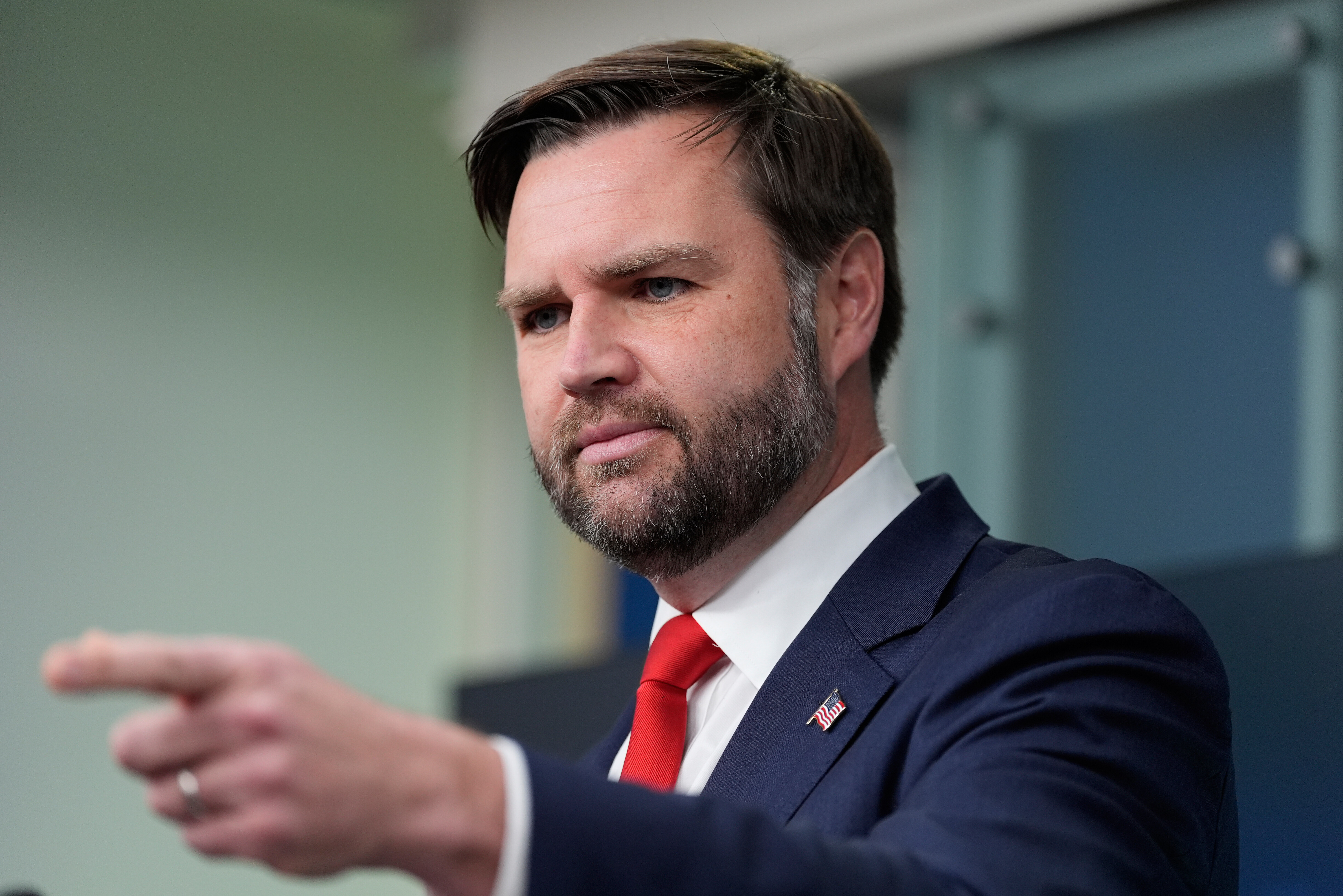


If the talks are successful, which is already in doubt, a ceasefire that began as a two-week endeavor could transition to something more lasting.
Rick Crawford, chairman of the House’s Select Committee on Intelligence, told "Washington Watch" on Thursday's there’s only one successful end to war with Iran.
“We’ve got to stop the ballistic missile production, got to deteriorate, dismantle, completely dismember their ability to launch any kind of strike, short, medium, long range, and then remove fissionable material,” he said.

Special Envoy Steve Witkoff and Jared Kushner, President Donald Trump’s son-in-law, will join Vance at the talks in Islamabad, Pakistan.
The goal is to reach a long-term peace, the White House announced Wednesday.
Vance had tough words for Iran when boarding Air Force Two Friday morning.
“We’re looking forward to the negotiation. I think it’s going to be positive. We’ll of course see.” He cited Trump in saying, “If the Iranians are willing to negotiate in good faith, we’re certainly willing to extend the open hand.” But he added, “If they’re going to try and play us, then they’re going to find that the negotiating team is not that receptive.”
Discussions are likely to begin as “proximity” talks with the U.S. and Iranian delegations in the same location but communicating through intermediaries.
In similar negotiations before U.S. air strikes against Iran began, the U.S. pushed for direct contact.
The talks are expected to begin sometime in the morning local time which could conceivably have them starting before midnight in the U.S. Islamabad is nine hours ahead of Washington, D.C.
“If they can get a deal, these are the three individuals I think could get it,” Crawford, an Arkansas Republican, told show host Tony Perkins.
But history suggests a deal will be “very, very difficult to execute,” he conceded.
Any news coverage of the current ceasefire is almost always described as fragile.
The U.S. and Iran have publicly issued dueling threats and have presented contradictory interpretations of the ceasefire terms raising the risk of collapse.
Ongoing attacks have been reported, and the Strait of Hormuz has not fully reopened.
For successful negotiations, Iran must be willing to compromise on its nuclear program, while the U.S. must be willing to offer meaningful sanctions relief.
Meanwhile, regional considerations — such as how Iran’s Lebanon-based militant proxy Hezbollah fits into the picture — are secondary, writes Chatham House, a London-based think tank which some analysts say leans slightly right.
“I think what we can agree on is that Iran can never have nuclear capability,” Crawford said. “They've demonstrated a willingness to breach any ethics as it applies to engagement with their neighbors, as it applies to even enemies. They’ve been talking about death to America, death to Israel since 1979.”
Iran’s history of deceit
Iran’s history of deceit complicates matters during and after any negotiated agreement, Crawford said.
It’s relationship with the International Atomic Energy Agency (IAEA) has been hit and miss with reduced cooperation in 2006, 2019 and 2021 then again with its most comprehensive and formal break from the group’s investigative efforts just last summer after its 12-day war with Israel.
“The IAEA has had problems being able to verify any of these agreements that have been put forward. They routinely either block access or just out-and-out lie about their current state to these oversight agencies that are there as a part of the agreement,” Crawford said.
He remains skeptical.
“I want to be positive and have a glass half-full look and approach to this, but how to you reach an agreement that is verifiable, that we can go into knowing that there is some sort of mechanism to enforce that agreement?”