


The Iranians may or may not understand that, Michael Rubin, a former Pentagon adviser, said on “Washington Watch” Wednesday.
Trump and Israeli Prime Minister Benjamin Netanyahu met at the White House Wednesday to discuss ongoing negotiations with Iran — particularly over its nuclear program and broader regional threats, such as ballistic missile development. Both leaders acknowledged that diplomacy with Tehran remains uncertain and unfinished.
Israeli concerns about Iran’s missile capabilities were a key part of Netanyahu’s push during the talks.
But talks will continue, Trump stated, a comment that likely surprised and disappointed many, especially Iranians who have buried their loves ones after two months of street protests.
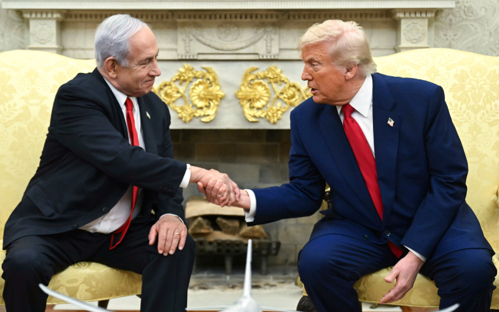 Netanyahu arrived in Washington aiming to shape the scope of U.S.–Iran talks and ensure Israel’s security priorities — including missiles and support for regional militant groups — are included in negotiations.
No definitive agreement was announced at the conclusion of the meeting. Both leaders agreed to keep coordinating, but Trump stopped short of promising tougher immediate action or a new joint strategy beyond continuing talks.
“This is typical Trump," Rubin, a staff advisor for Iran and Iraq during the George W. Bush administration, told show host Tony Perkins. "He really does sincerely want to get a deal. But where the Iranians may get him wrong is that he's not willing out of desperation to be strung along."
Rubin previously provided cultural and regional briefings to U.S. military personnel deploying to the Middle East and Afghanistan.
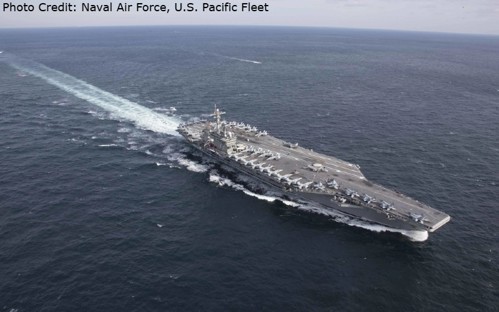 Because Trump won’t negotiate forever ,there is a second aircraft carrier headed to the region, Rubin said.
The total U.S. military footprint in the region now is estimated at 50,000 personnel.
The force is led by the USS Abraham Lincoln. That super carrier is carrying F-35C Lightning II stealth fighters, F/A-18E/F Super Hornets, electronic warfare aircraft, the E-2D Advanced Hawkeye for early warning and the CMV-22B Osprey for logistics.
The Lincoln is escorted by three Arleigh Burke-class destroyers.
Iran's ballistic missiles being watched closely
“Everything I hear is that behind the scenes, the two leaders, Donald Trump and Benjamin Netanyahu, are working in lockstep, and that extends to Marco Rubio, the secretary of state,” Rubin said.
Some reports indicated Netanyahu would provide additional intelligence for Trump regarding the status of Iran’s missile program.
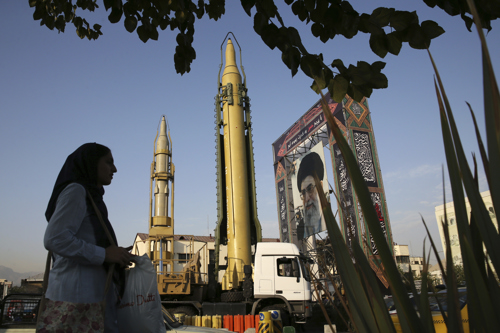 “The ballistic missile program is what determines the timing of any action,” Rubin said.
Israel launched its attack against Iran last June because of advances it saw in that program, he said.
“The window of opportunity was closing that had opened when Israel had earlier destroyed Iran’s anti-aircraft system,” he said.
It’s likely Netanyahu’s intent this week was to let Trump know where the Iranians are in the process of rebuilding their missile program.
“And to let Donald Trump know that the Iranians are probably going to try to drag you out past this (certain) point in time. That’s the point where there’s got to be a red line, and you’ve got to make a decision — or else we’re going to act unilaterally,” Rubin said.
 Sima Shine, a former senior Israeli intelligence official and current senior researcher at the Institute for National Security Studies, told Fox News Digital that limiting talks to the nuclear issue risks missing what Israel considers the broader threat.
Iran International reported in December that Iran was developing chemical and biological warheads for its ballistic missiles. Iran’s Islamic Revolutionary Guard Corps (IRGC) had accelerated work on unconventional missile payloads alongside upgrades to command-and-control systems, the outlet reported.
Iran attacked with missiles not long ago
Hundreds of Iranian missiles were launched toward Israel in major attacks in 2024 and 2025. Israel’s air defenses intercepted the vast majority though some missiles got though leading to real damage and casualties.
“A lot of people in Washington applauded that all but seven of them had been shot down or intercepted. The fact of the matter is that if those seven carried nuclear, biological or chemical warheads, we'd be talking about a very different discussion about whether the interception, the interdiction was successful or not,” Rubin said.
The gravest threat for Israel is not that the Iranian government might strike, but who exactly has control of its weapons.
If the regime collapses, radical elements of the IRGC could take matters into their own hands.
“If the regime is collapsing and make no mistake, the regime is teetering, what’s to stop the most ideological component of the Islamic Revolutionary Guard Corps, those with nuclear, potentially missiles or chemical weapons, from launching, knowing that there's going to be regime change in 24 hours afterwards?” Rubin said.