



Trump met with Syrian president Ahmed al-Sharaa at the White House Monday as al-Sharaa seeks international legitimacy and the rebuilding of a country torn by years of civil war under the rule of Bashar al-Assad.
Al-Sharaa was named president for a transitional phase by the Syrian General Command after the overthrow of al-Assad in late 2024.
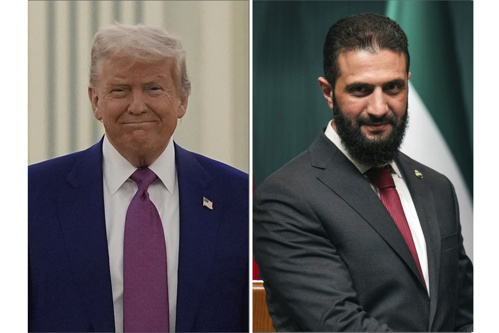 The first visit to Washington by a Syrian president came just days after the U.S. said al-Sharaa was no longer a “Specially Designated Global Terrorist” and announced a 180-day suspension of major sanctions against Syria.
That’s a lot of baggage for the former Al-Qaeda leader even though he’s pledged that Syria will join a U.S.-led coalition against the Islamic State terror group.
While al-Sharaa seeks to rebuild his image, there are issues in the present, too – most notably the persecution of Christians and ethnic minorities, the Druze and the Alawites, in Syria.
“Many people aren't aware, for example, that there were over a million Christians in Syria, and now there's less than 300,000," Charmaine Hedding, who leads the Shai Fund, said on Washington Watch Monday.
"This is predominantly because of what we call a slow-burn genocide, where the Christians are continuously being discriminated against, as are other religious minorities, such as the Druze and the Alawites," Hedding warned.
A different tune at home
Al-Sharaa’s actions and his show for the U.S. and other western nations aren’t matching up she told show host Jody Hice.
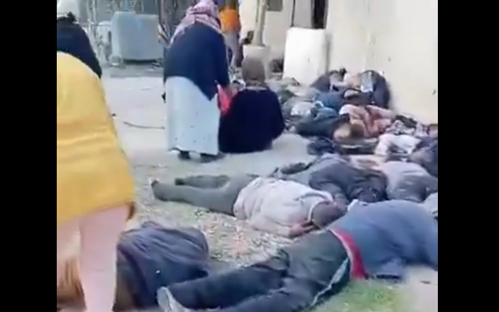 “The situation is pretty dire, and I think unless there's benchmarks put against President al-Sharaa, we're going to see more of the same,” Hedding said.
In June, a suicide bombing and shooting attack occurred at the Greek Orthodox Mar Elias Church in Damascus during Divine Liturgy. The attacker, Muhammad Zain al-Abidin Abu Uthman, opened fire and detonated an explosive vest, killing 31 people (including himself) and injuring 54 others.
Many Christian families report that even in relative safe-zones (“Valley of the Christians” etc) they feel constrained: “we're protected here, but we can’t move freely … the fear never leaves us,” said one Christian to Al-Monitor, a Middle East news outlet.
Attacks and discrimination are generally considered worse against the Druze and Alawites, religious sects formed out of Shia Islam and considered apostates by mainstream Sunni Muslims which make up the new government, reports New Lines Institute.
Pro-al-Sharaa forces in March massacred thousands of Alawites in a campaign that included 56 villages.
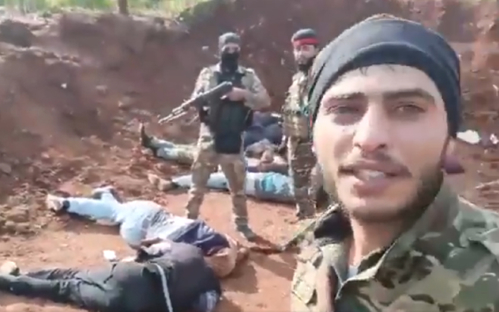 Killings and kidnappings were reported as masked gunmen on motorcycles fired into homes. There was property confiscation and forced evictions.
The Assad government offered Christians some measure of protection.
“It wasn't good. We know what he did. We know how many millions left the country. We know how many came out of the prisons, right, and we were thrilled when Assad's regime was finally overthrown. But what's happened is we've just exchanged it for another authoritarian regime, and this is a jihadi regime,” Hedding said.
Brigitte Gabriel, founder of ACT for America, agrees.
“This is the shocker for me. This man was in our prison, he was one of our prisoners because he was a terrorist. And now all of a sudden he's invited to the White House as a VIP guest as the president of Syria, and we are going to basically revamp our laws the way we treat Syria."
According to an analysis by the Foundation for Defense of Democracies, al-Sharaa was apprehended by U.S. forces on May 14, 2005, in the Nabi Yunis suburb of Mosul, while using the alias “Amjad Muzzafar Hussein Ali al Naimi."
He was transferred to the U.S.-run Camp Bucca prison in southern Iraq, where he remained until April 6, 2010, when handed over to Iraqi authorities; he was ultimately released on March 13, 2011, due to lack of evidence.

Gabriel says it is mind boggling that this is happening.
"But I trust President Trump. I trust his judgment. He knows what he's doing. Maybe they are thinking he is our enemy and in order for us to bring him into the world stage and get him connected with other world leaders, we give him a sense of identity and respect on the world stage, and maybe he will change his ways."
Syrian Christians are among the oldest Christian populations in the world with unbroken roots back to the first generation of the Church. It was the road to Damascus where Paul was blinded by a bright light and encountered Jesus. In the city itself, the Straight Street where Ananias found a blind Saul of Tarsus still exists today.
Trump is focused on protecting Christian populations around the world, Rep. Riley Moore (R-West Virginia) told Hice.
Syrian Christians “have been under constant attack by ISIS, I'm sure led at some point by this terrorist president. But if President Trump can somehow, and if anybody can it’s him, protect these Christians and these Druze in that country, that would be a huge win,” Moore said.
Syria-ISIS connections still strong
On the ground now in Syria regular army soldiers walk around with ISIS patches on their uniforms, she said.
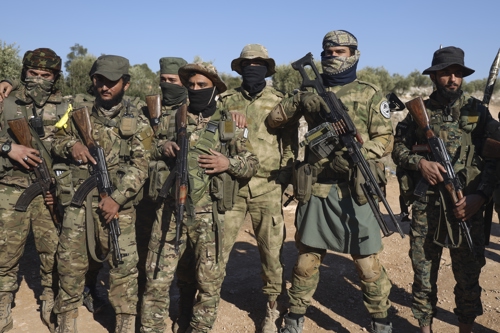 In addition to an end of violence, Hedding’s organization has called for the Syrian government to remove blockades from humanitarian corridors to allow for freedom of movement and to receive food and medicine.
Trump has described al-Sharaa as a “strong leader” with a “tough past” and has said, “We’ll do everything we can to make Syria successful.”
“We shouldn't be lifting the sanctions without decentralization, which means we don't