



The Court on Tuesday reversed a lower-court ruling that found the new map — which could add as many as five additional Republican seats to the U.S. House — constituted racial gerrymandering.
The Supremes disagreed in a 6-3 vote along party-line ideologies. The unsigned majority opinion said the lower court “improperly inserted itself into an active primary campaign.”
The dissenters had plenty to say as well with Justice Elena Kaga offering that the majority “ensures that many Texas citizens, for no good reason, will be placed in electoral districts because of their race. And that result, as this Court has pronounced year in and year out, is a violation of the Constitution.”
Bo French says the Court’s ruling is a big win.
“This is a huge deal, really, not just for Texas but for the nation,” he said on American Family Radio.
French, a candidate for the Texas Railroad Commission, told show host Jenna Ellis that Republicans are just trying to keep up in the redistricting wars.
“Democrats have been gerrymandering the blue states for decades. Republicans, frankly, have had trouble maintaining or even winning a majority in Congress because so many of these blue states, 30% or 40% of their citizens are Republicans but yet they have zero Republican congressional districts,” he said.
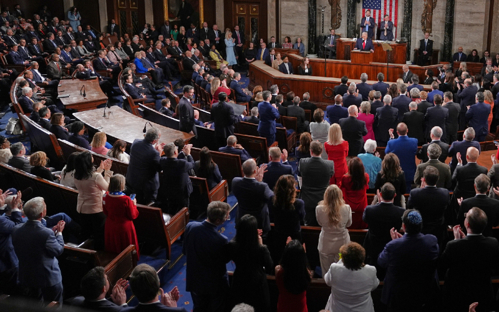 Massachusetts, Connecticut, Maine, New Hampshire, Rhode Island and Vermont have a combined 21 House seats. None are held by Republicans.
In most of those deep-blue New England states, maps are drawn by Democrat-controlled legislatures.
The last Republican to hold a House seat in any of these states was Bruce Poliquin, who served from 2015-2019. He lost the November 2018 race to Jared Golden, a U.S. Marine veteran, who continues to hold the seat.
Golden’s bio describes him as a centrist who emphasizes bipartisan cooperation.
Democrats fired the first shots in the current redistricting wars, French says.
“They have clearly violated what they hold up as the reason for trying to fight Texas, calling it racial gerrymandering or whatever. The reality is it's just always been about power for them.”
Texas' current redistricting efforts stem from the 2020 U.S. Census, which triggered the constitutionally mandated process to redraw legislative and congressional district boundaries based on new population data. The state gained two additional congressional seats, increasing its delegation to 38, necessitating a comprehensive redrawing of district lines.
The primary redistricting occurred in October 2021 during a special legislative session. The Republican-controlled 87th Legislature passed new maps for the U.S. House (S.B. 6), the Texas House (HB 1), and the Texas Senate (SB 4), which were signed into law by Gov. Greg Abbott on October 25, 2021.
The Supreme Court’s Texas ruling, which shows deference to state legislatures, may not shake up anything in New England, but it could in Virginia.
 The ruling may make it harder — though not impossible — for challengers to win by tilting the playing field in favor of state-drawn maps.
Democratic state lawmakers initiated a constitutional amendment process to temporarily reclaim redistricting authority from a bipartisan commission and return it to the legislature mid-decade.
The measure passed 51.6% to 48.4%.
The new Virginia map, which creates districts that would likely take the state from six Democrat seats and five Republican seats to a 10-1 Democrat edge, is currently in the hands of the state supreme court where oral arguments were heard Monday. A ruling could come late Tuesday or Wednesday.
Circuit Court Judge Jack Hurley ruled the referendum illegal due to procedural flaws and misleading ballot language.
A Florida redistricting plan unveiled by Gov. Ron DeSantis on Monday could further solidify its red-state status with a possible four more GOP seats.
The new Texas map is expected to create 30 Republican-leaning districts to eight Democrat-leaning districts, a net gain of four or five GOP wins out of Texas’ 38 U.S. House seats.
The map actually extends some Texas hospitality, French said.
“Texas has decided it's time we redo our districts to more reflect the red state that we are. Actually, we could have gotten rid of all of the Democrat districts if we had wanted to, of course, but we didn't. We still have a few.”