


Proposition 10 on the Texas Republican primary ballot presented the simple statement: “Texas should prohibit Sharia law.”
Voters responded yes with an overwhelming 94.81%.
Sharia law, in Islamic tradition, is a religious and legal framework derived from the Quran and Hadith, guiding personal and communal life.
 Critics, including Muslim civil rights groups, argue the campaign misrepresents Sharia and fuels anti-Muslim sentiment.
The primary catalyst was the proposal of EPIC City — renamed the “Meadow” — a 402-acre planned Muslim-majority development near Plano outside of Dallas that includes a mosque, school, and 1,000 homes.
Developers have said they follow U.S. and Texas laws, but conservative state leaders aren’t convinced. Gov. Greg Abbott, Sen. John Cornyn, and Attorney General Ken Paxton have raised national security concerns and launched investigations.
The Muslim population in Texas is estimated to be approximately 1% of the state's total population, with recent data indicating a range between 0.98% and 1.07%.
“When you reach four or 5% of your population is Muslim, you're going to see them start to demand things. And we're seeing that increasingly places across America,” Self told show host Tony Perkins.
Republican House Reps. Chip Roy and Self, both Texans, last December launched the Sharia-Free America Caucus.
The group was formed to oppose the influence of Sharia law in American legal and political systems, which its founders describe as incompatible with the U.S. Constitution and Western values.
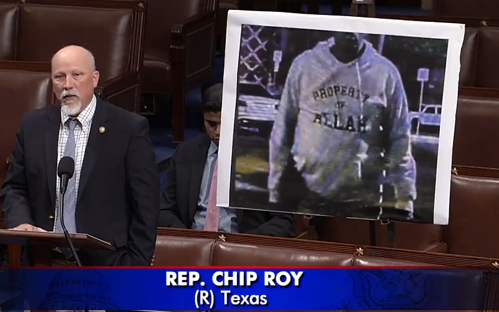 The caucus advocates for legislative action to prevent U.S. courts from considering Islamic law in rulings and supports restricting immigration for individuals who adhere to Sharia principles.
Once the caucus started more and more people felt free to share their concerns with the possibility of Sharia law gaining a foothold in their states.
“It’s widespread, and it’s growing,” Self said.
Hot topic in Texas
The Texas State Board of Education recently approved a preliminary draft of its revised social studies standards which limits how Islam is taught.
The standards remain hotly contested by conservatives and pro-Islamic voices in the state.
A final vote is expected in June.
“The Texas citizens stepped up to go before the state board of education and at the end of the day, (the board) voted to keep the Christian standards on which we are our civilization is based. They are not going to have Islam specific items in the curriculum. That's what (pro-Islamic voices) were asking,” Self said.
Supporters of a broader presence for Islam within the new standards say Islam is being misrepresented.

They say the new standards are an attempt to marginalize Islam by omitting its historical, scientific and cultural contributions while emphasizing extremism.
These supporters warn the curriculum risks teaching children to fear Muslim classmates and reinforces bias by framing Islam primarily through terrorism.
Critics object to, among other things, proposals that would teach the Prophet Muhammad married a minor or that violence defined his leadership, calling such claims inflammatory and historically inaccurate.
The question of whether Muhammad married a minor centers on Aisha, his youngest wife. Classical Islamic sources, including Sahih al-Bukhari, state that Aisha was betrothed at age six while Muhammad was in his 50s. This view is widely accepted in traditional Sunni scholarship.
The depiction of Islam that supporters favor omits key elements in telling its story, Self says.
Women, gays and Sharia law
Women are granted rights to education, inheritance, and modesty protections, but are generally seen as subordinate in legal and familial matters—such as in marriage, divorce, and testimony, where a woman’s testimony may count as half that of a man’s in some interpretations. Modest dress (hijab) is required, and gender segregation is encouraged in public life.
Homosexual acts are strictly prohibited in mainstream Sharia law with penalties — that could include harsh physical punishment or death — left to the discretion of authorities.
“An accurate depiction of Sharia would be much harsher than anyone realizes because that's the problem we're having, educating people on the dangers, on the horrors of full-blown Sharia,” Self said.
Self praised the citizens who spoke out against Sharia law and voted against it in Texas.
“It's a governance system that is incompatible with the U.S. Constitution. You cannot have two separate legal standards in America,” Self said.