

Netanyahu, the Israeli prime minister, took to social media Sunday to voice a stern rebuke of any proposal that would lead to a Palestinian state in Israel.
That was a day before the United Nations Security Council voted overwhelmingly to support President Donald Trump’s controversial plan. Key elements include an International Stabilization Force (ISF) and a “board of peace” to oversee reconstruction, governance reforms, and an eventual transition of authority away from Hamas.
Thirteen of 15 members voted in favor of the proposal with Russia and China abstaining.
Netanyahu praised other elements of the plan.
Hamas has strongly rejected the proposed ISF which would in effect take on the role of disarming Hamas.
 Also in the deal is language that envisions a “credible pathway to Palestinian self-determination and statehood.”
That specific plan is what Netanyahu objected to in an X post. “Our opposition to a Palestinian state in any territory has not changed," he wrote.. "Gaza will be demilitarized and Hamas will be disarmed from its weapons, either the easy way or the hard way. I do not need reinforcements and tweets and lectures from anyone."
Michael Rubin, a staff adviser on Iran and Iraq for the Secretary of Defense during the George W. Bush administration, said Netanyahu has a plan.
His “concern is mainly meant to blunt the criticism some of his conservatives in his coalition. I don’t think that anyone really takes that seriously. Look, Prime Minister Benjamin Netanyahu has always been consistent. He believes in a two-state solution, so long as the Palestinians acknowledge that one of those states will be a Jewish state,” Rubin said on Washington Watch Monday.
The peace plan addresses the rebuilding of Gaza. It does not address a Palestinian state in any other Israeli territory.
Israel’s West Bank – Judea and Samaria – has often been mentioned as the location for a possible Palestinian State.
Netanyahu in September, however, signed an agreement to move ahead with an expanded settlement plan for Judea and Samaria. The development plan, which includes 3,400 new homes for Israeli settlers, would cut off much of the West Bank from occupied East Jerusalem while linking up thousands of Israeli settlements in the area.
East Jerusalem carries particular significance to Palestinians as their choice for the capital of a future Palestinian state, Al-Jazeera, the Arabic news channel, reported.
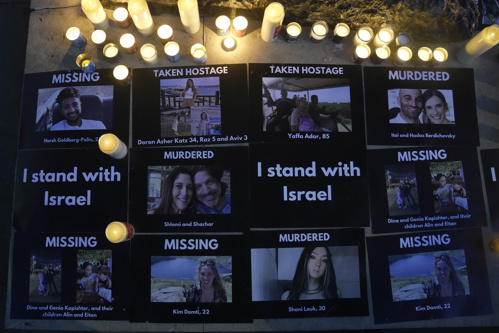 Gaza in effect existed as a Palestinian state before Hamas, its governing authority, launched from there its rampage of murder and kidnapping in southern Israel on Oct. 7, 2023.
Approximately 1,200 were killed by Hamas on that day, setting off the war that followed.
“Netanyahu has always been consistent. He believes in a two-state solution, so long as the Palestinians acknowledge that one of those states will be a Jewish state. Too often, Palestinian leaders will try to avoid that issue by saying we believe in two states, a Palestinian state and another Palestinian state,” Rubin told show host Tony Perkins.
While Netanyahu took a strong stance against a Palestinian state on Sunday, he praised the Security Council’s vote the next day.
“We believe that President Trump‘s plan will lead to peace and prosperity because it insists upon full demilitarization, disarmament and the deradicalization of Gaza,” Netanyahu’s office wrote on X Tuesday.
Netanyahu critics at home
Notably, Netanyahu did not issue a direct statement welcoming the approved resolution in Hebrew or on his personal accounts, against the backdrop of political tensions within his coalition over the resolution’s implication of future Palestinian statehood, The Times of Israel reported.
Netanyahu critics fault him for the Hamas build-up that led to the attacks.
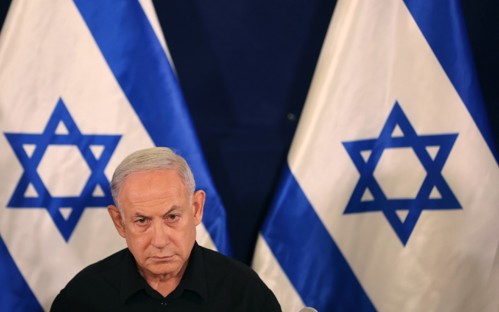 Opposition Leader Yair Lapid asserted in response to the resolution’s passage that Netanyahu only agreed to back the plan “under American pressure.”
Lapid added that “for years Netanyahu tried to separate Gaza from the West Bank, and from that grew the destructive policy of strengthening and funding Hamas while turning a blind eye to its armament,” The Times reported.
“It was a terrible strategic mistake, and it’s good that the Americans have put an end to it,” he added.