


The classroom syllabus, a common tool in higher education, is provided to students by the professor to give an outline of their class and its assignments.
That well-known tool proved helpful for Campus Reform. It used a popular data base, Open Syllabus Analytics, to track the popularity of classroom authors from 2008 to 2019. Those rankings show Plato, the Greek philosopher who learned from Socrates and taught Aristotle, ranked 19th in 2008. Even though Plato is credited with inventing the university setting with his Academy, his works had dropped to 53rd by 2019, according to the syllabus data base.
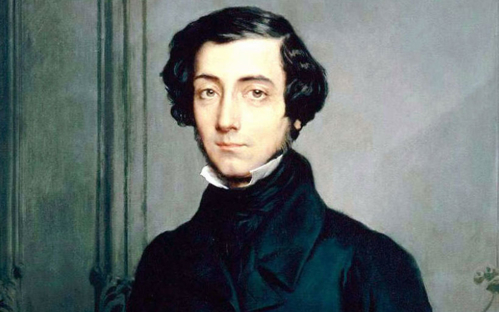 Alexis de Tocqueville, the French historian and writer (pictured at right) who travelled the U.S. in the 1830s, was cited by a classroom syllabus 4,552 times in 2008. A decade later, the man whose “Democracy in America” described the uniqueness of the American republic was referenced only 932 times in a classroom syllabus.
David Randall, research director at the National Association of Scholars, tells AFN the syllabus analysis confirms a drift from classic works in every discipline offered in modern-day higher education.
“You can't be a good sociologist anymore, you can't be a good biologist anymore,” he stresses, “if you lost your core text in every discipline. "

According to the Campus Reform analysis, more professors are exposing students to radical thinkers and writers. Gender theorist-author Judith Butler, who uses nonsensical “they/them” pronouns, is outranking William Shakespeare in classroom assignments, for example.
The analysis found the most popular author on a college syllabus is Michel Foucault, the late French philosopher. A homosexual, who died of AIDS in 1984, Foucault is perhaps most famous for his “History of Sexuality” that argues human sexuality is a social construct, not private and personal.
Alarmed by Faucault’s top ranking, Randall says it’s as if professors have never even questioned if their art class, or chemistry class, should include him.
“At this point a number of them are deliberately imposing radicalism,” she says of the classroom professors. “The younger generation, in particular, they don't know any different.”
 Randall, who is quoted in the Campus Reform story, told it a classical education has been the “birthright” of every college and university student who sets foot on an American campus going back generations.
Modern-day students, he said, are now being “condemned by their professors to ignorance of Western civilization.”
What those students are being taught instead was hinted at in the College Reform story: Karl Marx, the communist philosopher, is among the top classroom assignments, too.