


The suspects were allegedly involved in a conspiracy to arrange sham marriages between U.S. citizens and immigrants living illegally in the U.S. so the latter could obtain green cards and citizenship.
For $38,000 to $40,000 per marriage, prosecutors say the operation arranged 18 to 20 sham marriages annually over the past 12 years.
All six defendants face charges of harboring illegal aliens, conspiracy to harbor illegal aliens, conspiracy to commit marriage fraud and marriage fraud.
Prosecutors identify Jennifer Gonzalez, 43, of Fall River, Massachusetts, as the ringleader. She allegedly recruited U.S. citizens to marry immigrants, coached couples to fabricate evidence of legitimate relationships and used disguised contracts to conceal payments.
Gonzalez, who reportedly invested the proceeds in businesses and real estate in the Dominican Republic and improperly received more than $120,000 in Massachusetts food assistance benefits, also has prior convictions for assault and battery and fraud.
Investigators believe she generated more than $6 million in profits in the marriage ring.
Five defendants were arrested Oct. 21 while a sixth was already serving a state prison sentence. The allegations against them have not yet been proven in court.
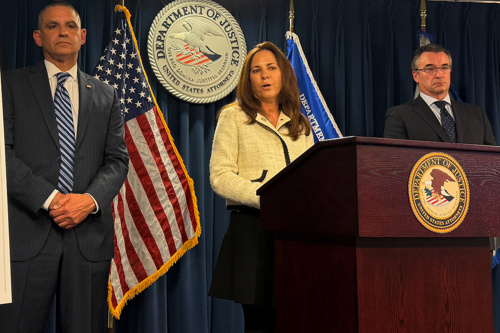 "To see a for-profit business whose sole purpose is helping people cheat and skip the line by simply paying for it must be so offensive and disheartening to those who follow our country's laws," Leah Foley, U.S. attorney for the District of Massachusetts, said during a press conference in Boston earlier this week (pictured left).
She said the American dream "is not for sale" and vowed to hold accountable those who attempt to profit by abusing the immigration system.
John Soares, an investigator for the Department of Homeland Security, said the defendants are accused of enriching themselves to the tune of hundreds of thousands of dollars annually "through sham marriages [and] other fraudulent schemes to include SNAP fraud, housing fraud and unemployment fraud."
Conservative commentators have cited the case as an example of how sanctuary-state policies and weak immigration enforcement can be exploited for profit, raising concerns about alleged fraud and the misuse of taxpayer-funded benefits.
Gov. Maura Healey (D) consistently maintains that Massachusetts is not a sanctuary state, and while no official state law declares it as such, it is often classified as one by federal authorities and immigration groups due to a 2017 state court ruling restricting cooperation with U.S. Immigration and Customs Enforcement detainers and the presence of numerous local sanctuary cities.
According to the federal criminal complaint, Gonzalez allegedly told an undercover cooperating witness that Massachusetts was a sanctuary state and said, "the state defends us very much." She also reportedly described Massachusetts as "the best place for you to be" because immigrants could receive health insurance and other assistance.