


Rep. Brad Knott (R-NC) told the “Washington Watch” program his Right to Worship Act allows churches to pursue civil damages in federal court if protesters disrupt their worship service.
“This is not a criminal prosecution,” Knott, a former federal prosecutor, pointed out.
“If the bill passes and becomes law, you are no longer helpless,” Knott, referring to church congregations, said. “You will have civil authority to sue and to recover monetary damages if they violate your right to worship.”

The bill is co-sponsored by Republican and Democrat lawmakers. Knott and Rep. Tom Suozzi (D-NY) have introduced it in the House. Senators Ted Cruz (R-TX) and Elissa Slotkin (D-MI) introduced the Right to Worship Act in the Senate.
The bill would also create a 100-foot "buffer zone" around a house of worship during religious services.
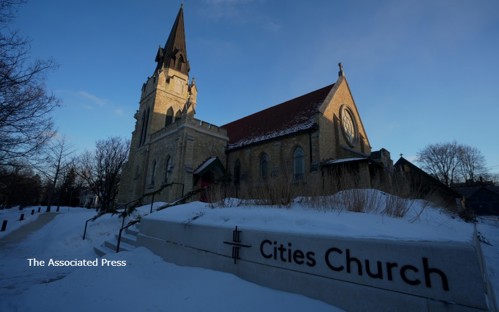
Knott acknowledged the idea for the bill came after left-wing protesters entered a Minnesota church, and disrupted its Sunday morning worship, in January. That church, Cities Church, is a Southern Baptist congregation located in St. Paul.
That protest was organized and led by two groups, Black Lives Matter Minnesota and Racial Justice Network. They targeted Cities Church after learning one of its staff members also works for ICE, Immigrations and Customs Enforcement.
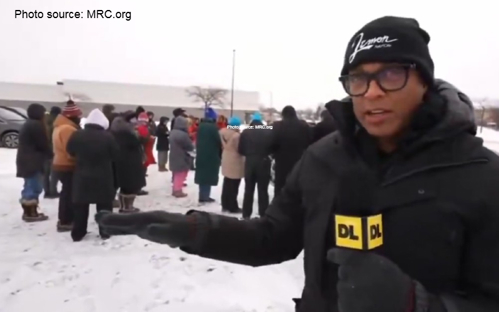 The church protest gained national attention after Don Lemon, the former CNN correspondent, made himself a focal point as it unfolded. Tipped off about the church invasion, he filmed himself on the scene (pictured at right) with what he called “resistance protesters” who were meeting in a parking lot for final instructions before traveling to the church.
Inside the church, Lemon filmed the chanting, fist-raising protesters walking down the aisles while frightened children cried in the pews. He also filmed himself arguing with church members, including lead pastor Jonathan Parnell, in interviews that were confrontational and hostile.
Church members said they were blocked from exiting the sanctuary by the protesters, and in the parking lot they were also harassed and followed to their vehicles.
Lemon, who said he was exercising his First Amendment right as news reporter that morning, later told a podcast the white churchgoers felt “entitled” and that entitlement came from “white supremacy.”
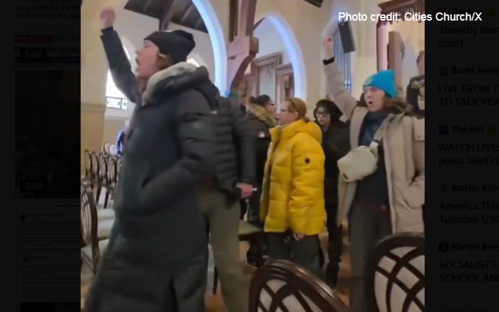 Lemon and more than 30 others who stormed into Cities Church are now fighting the U.S. Department of Justice after it charged them for violating the FACE Act, the federal abortion law that also protects houses of worship.
The main reason for introducing the Right to Worship Act, Knott told the program, is that city and state prosecutors refused to bring charges against the left-wing protesters for disrupting the church service.
Irene Kao, the St. Paul city attorney, said in a statement “current evidence is insufficient to meet that standard for criminal charges under Minnesota state statutes.”
“If the local prosecutors do not believe this is something worth pursuing, then congregants, regardless of their faith or their persuasion, are left with no remedy,” the congressman said.
 Addressing free speech concerns, show host Jody Hice pointed out the bill’s language addresses the behavior of protesters that day, not a standard sidewalk protest on public property
“Why is that an important distinction?” Hice asked the congressman and former prosecutor.
“People have the right to protest,” Knott stated. “They have the right to voice concerns over a Christian church, a synagogue, a Jewish faith, a mosque, a Muslim faith, but they don't have the right to prevent individuals from worshiping.”